
www.industry-india.com
06
'26
Written on Modified on
Smallholder Soil Carbon Quantification Under Verra VM0042
Grow Indigo implemented Regrow’s DNDC biogeochemical modeling system to quantify verified soil carbon credits across smallholder farming networks in northern India.
www.regrow.ag
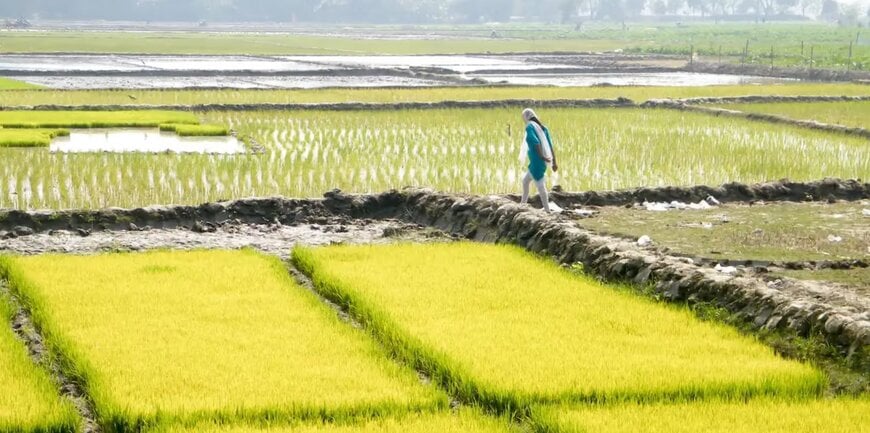
Multi-crop agricultural landscapes in northern India face mounting challenges from groundwater depletion, soil degradation, and greenhouse gas emissions. Traditional flooded paddy rice cultivation generates anaerobic soil conditions that release substantial volumes of methane, representing approximately 10 to 12 percent of global methane output. While transitioning to practices such as direct seeding of rice reduces methane generation and conserves irrigation water, smallholder multi-cropping rotations involving rice, wheat, and maize introduce variable soil chemistry. Altering water regimes can inadvertently elevate nitrous oxide fluxes depending on nitrogen fertilizer applications. Capturing these fluctuating greenhouse gas balances across fragmented smallholder plots requires auditable, high-resolution scientific quantification rather than generic regional emission factors.
Biogeochemical Modeling Architecture
To resolve the complex emission dynamics of smallholder fields across approximately 140,000 hectares in Punjab and Haryana, Grow Indigo integrated Regrow’s operational Denitrification-Decomposition modeling platform for the Aadi Project (VCS Project 2590). Grow Indigo selected the DNDC engine because it tracks daily carbon and nitrogen biogeochemistry at field scale. Unlike static accounting mechanisms, DNDC continuously simulates microbial activity, organic matter turnover, and daily soil moisture shifts. This temporal resolution captures short-duration nitrous oxide spikes during field drainage transitions alongside progressive methane reductions in paddies.
Integration and Verification Methodology
Implementation combined field-level agronomic management data, remote sensing satellite observations, and the calibrated DNDC engine. Regrow supplied the computational quantification infrastructure, calibrating soil parameters to simulate daily greenhouse gas exchanges and long-term organic carbon accumulation across diverse soil classifications. The modeled datasets aligned directly with Verra’s VM0042 methodology for improved agricultural land management, ensuring calculation transparency and third-party auditability across hundreds of thousands of independent smallholder plots.
Quantified Environmental and Economic Outcomes
The deployment enabled the issuance of 57,463 carbon credits under Verra VM0042, marking the first verified smallholder soil carbon crediting under this standard globally. Agronomic improvements simultaneously optimized water consumption and stabilized soil structure across the project area. Under the operational revenue model, 75 percent of the carbon credit proceeds flow directly to participating farmers, establishing verified economic incentives for sustainable land stewardship.
Edited by Evgeny Churilov, Induportals Media - Adapted by AI.
www.regrow.ag
