
www.industry-india.com
09
'26
Written on Modified on
Tata Power strengthens Mumbai’s grid with 60 MWh battery storage deployment
Three installations support industrial-scale energy management, peak load balancing and optimized power procurement, advancing the company’s planned 200 MWh initiative.
www.tatapower.com
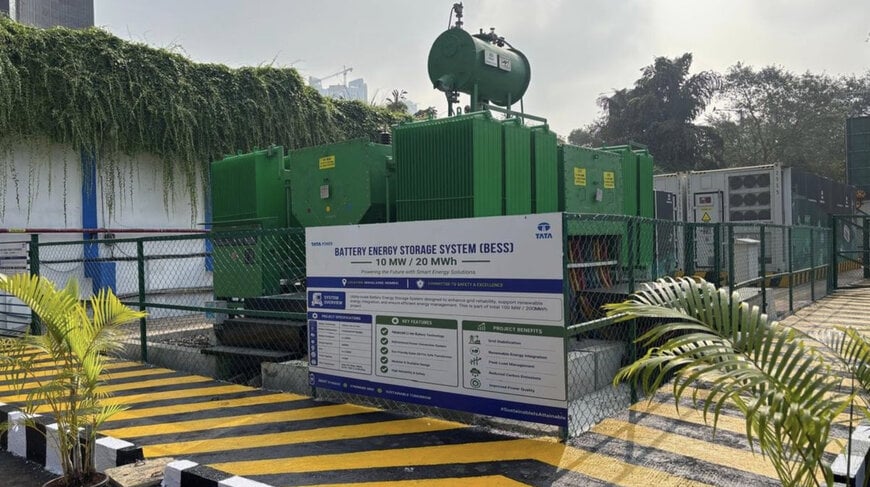
High-density urban electrical grids face mounting supply-demand imbalances driven by rapid commercial electrification, localized infrastructure expansion, and diurnal solar generation curves. To address these operational constraints across Mumbai, utility operator Tata Power has brought 60 MWh of Battery Energy Storage Systems (BESS) into active service across three distribution nodes.
Urban Distribution Bottlenecks and Peak Load Dynamics
Dense metropolitan power distribution networks operate under severe spatial and thermodynamic constraints that complicate traditional capacity expansion. In major load centers, peak electrical demand consistently occurs during evening windows when commercial, industrial, and domestic cooling loads coincide with the loss of utility-scale and distributed photovoltaic output. Distribution utilities frequently rely on high-cost spot-market power purchases or thermal peaking plants to balance these sudden load swings, increasing overall power procurement expenditures and taxing downstream substation assets.
Concurrently, regional grids require localized frequency regulation, reactive power injection, and fast-ramping reserves to manage transient fluctuations. Upgrading underground high-voltage feeders and installing supplementary substations across built-up urban corridors involves lengthy civil disruption, complex right-of-way permissions, and prohibitive capital expenditures. Utilities face the technical necessity of deploying decentralized, high-energy-density assets at existing substation nodes to flatten local load curves and supply contingency power directly to critical municipal infrastructure.
Architecture and Operating Principles of Decentralized Energy Storage
Tata Power deployed the 60 MWh storage capacity across three existing substation hubs: Mahalaxmi, Saki, and Mankhurd. These nodes serve as strategic interconnection points across Mumbai's distribution network, which supplies electricity to more than 800,000 consumers.
The installations function through active energy arbitrage. During daytime hours when wholesale grid electricity costs decrease due to widespread solar injection, the bi-directional inverter systems draw power to charge the battery banks. During evening peak-demand hours, the battery management systems switch into discharge mode, dispatching stored energy directly into the local distribution grid to bypass volatile evening tariffs and reduce transmission corridor congestion.
From a control engineering perspective, the systems are configured to execute between 1 and 1.5 complete charge-discharge cycles daily. High ramp-rate capabilities and sub-second automated control loops enable rapid active power delivery during dynamic load surges, providing localized frequency stabilization and dynamic load-following support. Furthermore, the power conversion systems incorporate grid-forming inverters and localized auxiliary generation to provide black-start functionality, allowing distribution engineers to energize isolated substation buses and expedite feeder restoration following broader grid disturbances.
Critical Infrastructure Defense and System Scalability
The operational 60 MWh capacity represents the initial phase of a broader grid modernization program. In April 2025, the Maharashtra Electricity Regulatory Commission (MERC) granted regulatory approval for Tata Power to deploy 200 MWh of decentralized BESS assets across 10 strategic locations throughout Mumbai.
The primary operational mandate of the expanded multi-node storage network is the protection of essential public infrastructure during power supply interruptions. By embedding localized storage reservoirs near major transit and healthcare nodes, the distribution network can maintain continuous power flow to hospitals, mass transit Metro corridors, aviation facilities, and mission-critical data centers during upstream grid failures. The installations also provide localized reactive power support, stabilizing substation bus voltages and reducing reactive losses on medium-voltage lines.
Additional Context:
This section details technical specifications and competitive benchmarking not included in the original product announcement.
Metropolitan distribution-level energy storage has emerged as a distinct grid architecture in India following early pilot deployments, notably the 10 MW / 10 MWh lithium-ion installation commissioned by Tata Power-DDL at Rohini, Delhi, in 2019. While utility-scale storage in India has historically focused on central transmission interconnections to firm utility-scale solar parks, urban distribution-connected BESS targets local feeder congestion, transformer thermal loading, and local outage mitigation.
Grid integration of utility-scale electrochemical systems in India is governed by the Central Electricity Authority (Technical Standards for Connectivity to the Grid) Regulations and the Indian Electricity Grid Code (IEGC). Under these regulatory frameworks, storage systems providing Fast Frequency Response (FFR) and Primary Frequency Response (PFR) must demonstrate response actuation within 1 to 10 seconds of frequency excursions outside the standard 49.90–50.05 Hz operational band. The inclusion of black-start capability requires inverters capable of seamless transition between grid-following and grid-forming modes, managing inrush currents and transformer magnetizing currents without external reference voltages.
In national planning benchmarks, the Central Electricity Authority's National Electricity Plan projects a required BESS capacity of 8.68 GW / 82.37 GWh by financial year 2026–27, expanding to 41.65 GW / 208.25 GWh by 2029–30 to support national renewable integration targets. Concurrently, the Ministry of Power's Energy Storage Obligation (ESO) mandates an increasing proportion of distribution company energy procurement from storage-backed resources, beginning at 1% and scaling to 4% by 2029–30. The 60 MWh deployment across Mumbai provides an empirical baseline for urban utilities meeting mandatory storage trajectories without requiring extensive real estate acquisition.
Edited by Natania Lyngdoh, Induportals editor, with AI assistance.
www.tatapower.com
