
www.industry-india.com
12
'26
Written on Modified on
6 GW HVDC Transmission Links India’s Renewable Power Nodes
Adani Energy Solutions and Japanese banks finance integrated high-voltage network for renewable grid evacuation.
www.adani.com
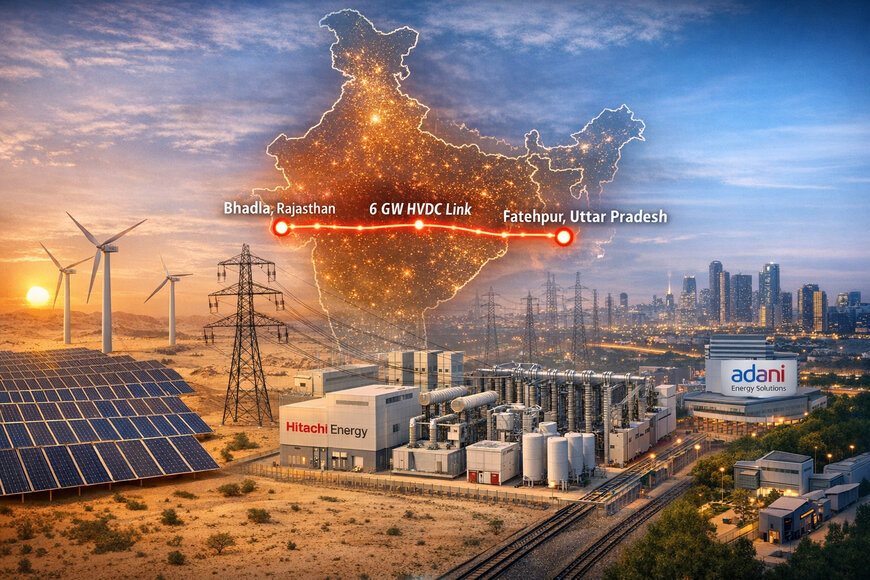
Adani Energy Solutions Ltd. and a consortium of Japanese financial institutions have partnered to develop a high-capacity high-voltage direct current (HVDC) transmission corridor to support solar and wind power integration into India’s electric grid. The agreement covers financing and technology deployment for an industrial-scale renewable evacuation system.
Context of the Cooperation
Adani Energy Solutions Ltd. (AESL), the largest private energy transmission company in India, is advancing grid infrastructure to enable large-scale renewable integration from generation hubs to load centers. The cooperating partners include a consortium of Japanese banks, notably MUFG Bank Ltd. and Sumitomo Mitsui Banking Corporation (SMBC), which provide long-term project financing, and Hitachi Energy, which contributes advanced HVDC system technology implemented in collaboration with Bharat Heavy Electricals Limited (BHEL) under India’s manufacturing ecosystem.
The industrial challenge addressed by this cooperation is the need for efficient transmission of large volumes of variable renewable power solar and wind from geographically distant generation regions, such as Rajasthan, to demand centers in northern India. Conventional alternating current (AC) transmission exhibits higher losses and stability constraints over long distances, making HVDC a preferred technical solution for bulk energy transfer at lower system losses.
Technical Solution and Responsibilities
The technical solution is a ±800 kV HVDC transmission corridor approximately 950 kilometres long, designed as a dedicated “green evacuation” backbone. With an evacuation capacity of 6 000 MW, the system uses voltage source converter (VSC)-based HVDC technology capable of bidirectional power flow and precise control of active and reactive power. Such systems improve grid stability and reduce transmission losses compared with equivalent high-voltage AC links.
Adani Energy Solutions is responsible for overall system design, interface with India’s national grid, and integration with local infrastructure. Hitachi Energy, in collaboration with BHEL, supplies and configures the converter stations and control systems to meet required performance parameters under established electrical grid standards. The Japanese banks structure debt financing under a green loan framework aligned with the Equator Principles, enabling classification of the financing as sustainable.
Deployment and Implementation
The corridor will connect the solar-rich Bhadla region in Rajasthan to Fatehpur in Uttar Pradesh, serving as a transmission artery into the northern grid. Commissioning is scheduled by 2029. Implementation phases include land acquisition, right-of-way clearing, civil work for converter station sites, installation of transmission conductors, and integration with existing substations and grid operation systems. AESL’s engineering teams coordinate with regional grid operators to sequence commissioning activities and ensure interface compatibility with national grid protection and control schemes.
Applications and Use Cases
The primary application is renewable energy evacuation and grid strengthening. By transmitting up to 6 000 MW of renewable power, the corridor will facilitate the delivery of utility-scale solar and wind generation to industrial clusters, urban loads, and large consumers. Technically, the HVDC link reduces power transfer constraints and supports grid frequency control under high variable generation conditions.
Expected Impact
Upon completion, the corridor is expected to decrease transmission losses compared with equivalent AC paths, support stability margins in northern grid regions, and enable higher penetration of renewable generation without compromising operational reliability. Connecting distant renewable sources to demand centers contributes measurable improvements in utilization of clean energy assets and grid flexibility. The cooperation also reflects broader industrial and financial linkages between India and Japan in energy infrastructure deployment.
www.adani.com
