
www.industry-india.com
22
'26
Written on Modified on
Control Software Deployment for Gigawatt-Scale Battery Energy Storage
Emerson and Adani Green Energy cooperate to integrate digital infrastructure into a utility-scale battery storage facility.
www.emerson.com
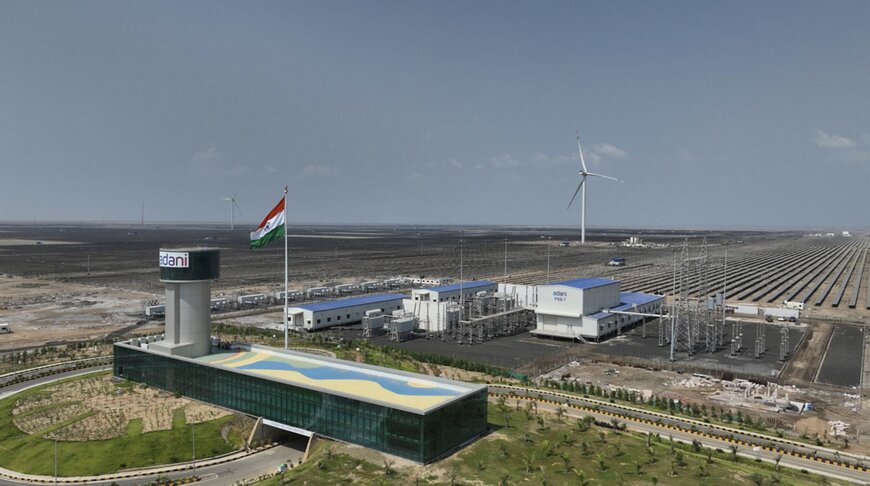
Adani Green Energy Limited's 30 GW renewable energy project in Khavda, Gujarat, India. Photo courtesy of Adani Green Energy.
Emerson and Adani Green Energy Limited have partnered to implement a supervisory control and data acquisition system for a 3.55-gigawatt-hour battery energy storage system. This cooperation targets the renewable energy sector, deploying automation software to stabilize electrical grid operations and manage large-scale power distribution.
Strategic Cooperation for Grid Stability
Emerson, a supplier of industrial automation solutions, and Adani Green Energy Limited (AGEL), a renewable energy network operator, collaborated to address the technical challenges of utility-scale energy storage. The deployment of a 3.55 GWh battery energy storage system (BESS) required a control architecture capable of processing large volumes of operational data to maintain grid stability. Cooperation was necessary to integrate Emerson’s automation platform with AGEL's renewable energy ecosystem, ensuring the hardware and software could operate continuously on a gigawatt scale.
Technical Solution and Responsibilities
Under the agreement, Emerson provides its Ovation Green SCADA platform, Ovation 4.0 software, and OCR3000 controllers, functioning as the primary digital framework for the facility. AGEL is responsible for the physical deployment and integration of the battery assets. At the system level, the SCADA software consolidates and processes data from energy conversion systems, battery management systems, high-voltage switchboards, and remote network terminal units. This architecture enables centralized, real-time monitoring and automates the charge and discharge cycles of the battery modules in compliance with grid transmission standards.
Deployment and Infrastructure Integration
The control system is deployed at a single-site battery storage facility in Khavda, Gujarat, India. The integration phase linked the SCADA software with the existing physical infrastructure, allowing operators to manage millions of distinct data points from a unified interface. Emerson engineers provided the control logic and software integration required to connect the diverse subsystems, facilitating a 10-month implementation timeline from the commencement of site construction to operational readiness.
Renewable Applications and Use Cases
The targeted application area is the utility-scale power generation and renewable energy integration sector. Concrete technical use cases include load shifting, peak shaving, and frequency regulation on the electrical grid. By automating these processes, the system provides operational benefits such as increased process stability, higher utilization of renewable assets, and reduced risk of grid overloads during peak generation periods.
Expected Operational Impact
The implementation of the automated control system allows the 3.55 GWh facility to maximize energy dispatch efficiency. By utilizing deterministic controllers to manage the battery management systems and high-voltage switchboards, the solution structurally lowers the latency of grid response times. This mechanism ensures a reliable supply of baseline power and prevents destabilization within the regional electrical grid, securing business continuity for the network operator.
Edited by Aishwarya Mambet, Induportals Editor, with AI assistance.
www.emerson.com
Emerson and Adani Green Energy Limited have partnered to implement a supervisory control and data acquisition system for a 3.55-gigawatt-hour battery energy storage system. This cooperation targets the renewable energy sector, deploying automation software to stabilize electrical grid operations and manage large-scale power distribution.
Strategic Cooperation for Grid Stability
Emerson, a supplier of industrial automation solutions, and Adani Green Energy Limited (AGEL), a renewable energy network operator, collaborated to address the technical challenges of utility-scale energy storage. The deployment of a 3.55 GWh battery energy storage system (BESS) required a control architecture capable of processing large volumes of operational data to maintain grid stability. Cooperation was necessary to integrate Emerson’s automation platform with AGEL's renewable energy ecosystem, ensuring the hardware and software could operate continuously on a gigawatt scale.
Technical Solution and Responsibilities
Under the agreement, Emerson provides its Ovation Green SCADA platform, Ovation 4.0 software, and OCR3000 controllers, functioning as the primary digital framework for the facility. AGEL is responsible for the physical deployment and integration of the battery assets. At the system level, the SCADA software consolidates and processes data from energy conversion systems, battery management systems, high-voltage switchboards, and remote network terminal units. This architecture enables centralized, real-time monitoring and automates the charge and discharge cycles of the battery modules in compliance with grid transmission standards.
Deployment and Infrastructure Integration
The control system is deployed at a single-site battery storage facility in Khavda, Gujarat, India. The integration phase linked the SCADA software with the existing physical infrastructure, allowing operators to manage millions of distinct data points from a unified interface. Emerson engineers provided the control logic and software integration required to connect the diverse subsystems, facilitating a 10-month implementation timeline from the commencement of site construction to operational readiness.
Renewable Applications and Use Cases
The targeted application area is the utility-scale power generation and renewable energy integration sector. Concrete technical use cases include load shifting, peak shaving, and frequency regulation on the electrical grid. By automating these processes, the system provides operational benefits such as increased process stability, higher utilization of renewable assets, and reduced risk of grid overloads during peak generation periods.
Expected Operational Impact
The implementation of the automated control system allows the 3.55 GWh facility to maximize energy dispatch efficiency. By utilizing deterministic controllers to manage the battery management systems and high-voltage switchboards, the solution structurally lowers the latency of grid response times. This mechanism ensures a reliable supply of baseline power and prevents destabilization within the regional electrical grid, securing business continuity for the network operator.
Edited by Aishwarya Mambet, Induportals Editor, with AI assistance.
www.emerson.com
