
www.industry-india.com
17
'26
Written on Modified on
B&R helps Autosys advance insulin pen manufacturing in India
The ACOPOStrak transport system enables automated assembly, in-process inspection and consistent product handling while reducing manual intervention.
www.br-automation.com
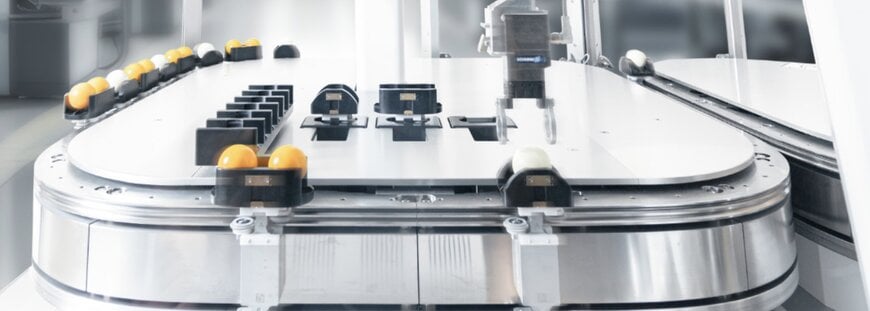
Global pharmaceutical and medical device manufacturers scaling up production of injectable drug delivery systems—such as disposable and reusable insulin pens—face stringent regulatory scrutiny alongside surging patient demand. Insulin pens rely on tightly toleranced mechanical subassemblies, including dose-dialing mechanisms, lead screws, cartridge holders, and spring-loaded injection assemblies, where micro-dimensional deviations can lead to dosing inaccuracies or device failure. Traditional rotary indexing tables and fixed-pitch synchronous conveyors impose rigid cycle-time bottlenecks, require extensive mechanical retooling during product changeovers, and struggle to accommodate variable dwell times for precision optical inspection. Furthermore, cleanroom medical device manufacturing prohibits polymer-on-polymer wear particles generated by conventional plastic track rollers, which can contaminate sterile assemblies. Overcoming these manufacturing constraints requires adaptive electromagnetic track systems engineered with cleanroom-grade metallic contact surfaces and sub-millisecond synchronized machine vision.
Adaptive Electromagnetic Transport and Metal-to-Metal Cleanroom Upgrade
To elevate product consistency, operational throughput, and hygienic compliance in injectable device assembly, Autosys deployed a fully automated insulin pen manufacturing system powered by B&R’s ACOPOStrak intelligent transport system. Configured with a specialized metal-to-metal upgrade, the linear motor track architecture eliminates polymer roller abrasion, preventing particulate generation and supporting strict cleanroom hygiene standards while minimizing manual operator intervention across the production line.
Unlike conventional mechanically linked conveyors, ACOPOStrak utilizes independently controlled electromagnetic shuttles that move each insulin pen subassembly individually through assembly, dosing calibration, and testing stations. This independent shuttle control enables dynamic product grouping, seamless pitch adaptation between stations of varying cycle times, and real-time diversion of defective assemblies via high-speed magnetic diverters without halting upstream or downstream line operations.
Integrated Machine Vision and Life Sciences Automation Leadership
Synchronized directly with the track controller, B&R’s integrated machine vision system performs continuous in-process optical inspection—verifying component presence, dimensional alignment, assembly integrity, and graduation markings at full production speed. Pratip Samata, Regional Managing Director for Southern and Eastern Asia at ABB’s Machine Automation division, noted that the deployment evolved from initial technical discussions at B&R’s India Innovation Day into a fully operational production line demonstrating intelligent automation for medical device manufacturing in India and international markets.
Additional Context
This section details technical specifications and competitive benchmarking not included in the original product announcement.
In medical device assembly governed by ISO 13485 quality management systems, FDA 21 CFR Part 820 Good Manufacturing Practice (cGMP) mandates, and ISO 14644 cleanroom classifications, linear motor transport systems operate on the long-stator synchronous linear motor principle: stationary electromagnetic coils embedded within modular track segments generate a traveling magnetic field that propels passive permanent-magnet shuttles without trailing cables. On standard industrial tracks, shuttles run on polymer guide rollers that shed microscopic wear debris over millions of cycles; B&R’s metal-to-metal upgrade replaces polymer wheels with hardened stainless-steel guide rollers running on precision-ground stainless-steel rails, raising cleanroom compatibility while permitting washdown and sterilization protocols. Furthermore, running B&R’s smart cameras and programmable strobe lighting over the same deterministic POWERLINK real-time Ethernet network as the ACOPOStrak segments enables microsecond-level position-triggered image acquisition (on-the-fly inspection) without slowing shuttle velocity, while simultaneously logging serialized electronic device history records (eDHR) for every individual insulin pen.
Within the adaptive linear transport and medical device assembly automation sector, B&R’s ACOPOStrak benchmarks directly against competing electromagnetic track systems from Beckhoff Automation (XTS — eXtended Transport System, including its hygienic stainless-steel variants), Rockwell Automation (MagneMotion QuickStick and iTRAK intelligent track systems), Bosch Rexroth (ctrlX FLOWHS), and ATS Automation / SuperTrak CONVEYANCE. While Rockwell’s MagneMotion and SuperTrak have historically held strong footprints in North American pharmaceutical and autoinjector assembly lines—and Beckhoff’s XTS offers compact footprint flexibility for small-part assembly—B&R differentiates ACOPOStrak through high-speed magnetic diverter switches (capable of splitting and merging product flows at full speed without moving track mechanics) and native, single-environment integration between the track motion controller, robotics, and B&R’s embedded machine vision portfolio inside Automation Studio. By pairing the metal-to-metal cleanroom ACOPOStrak configuration with synchronized vision inspection for Autosys, ABB and B&R showcase a scalable blueprint for Indian pharmaceutical and medtech OEMs transitioning from semi-automated rotary dial machines to flexible, Industry 4.0-compliant assembly lines.
Edited by Romila DSilva, Induportals Editor, with AI assistance.
www.br-automation.com
