
www.industry-india.com
19
'26
Written on Modified on
GEA Launches Online Calculator to Evaluate Industrial Vapor Recompression
GEA introduces the free meVap eCalculator web tool to model site-specific steam savings, operating costs, and emissions for mechanical vapor recompression electrification.
www.gea.com
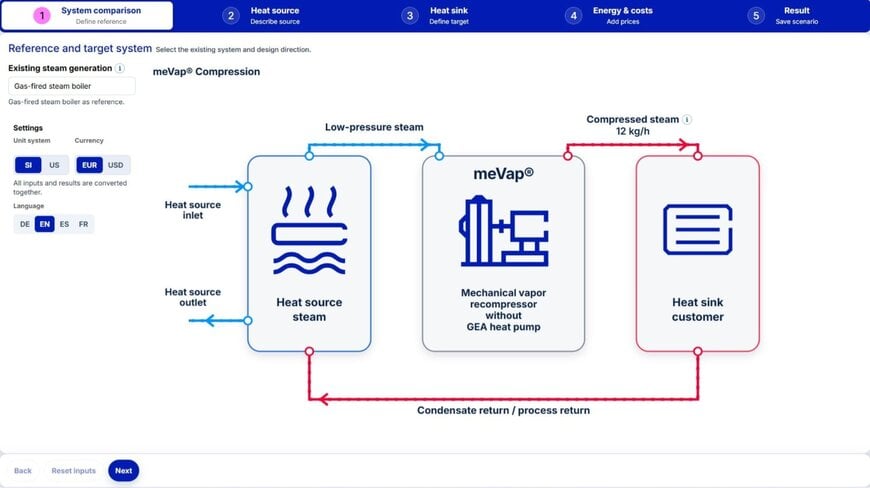
Energy-intensive process industries—including dairy, food, beverage, chemical, and pharmaceutical manufacturing—rely heavily on thermal unit operations such as evaporation, crystallization, and distillation. Historically, these processes have depended on fossil-fuel-fired boilers to generate primary live steam, resulting in substantial operational expenditures and direct carbon dioxide emissions. While mechanical vapor recompression (MVR) offers a proven pathway for industrial process electrification by recycling waste vapor enthalpy, plant engineers and financial decision-makers frequently hesitate to initiate capital projects due to uncertainty regarding site-specific economic feasibility. Local electricity-to-fuel price ratios, carbon pricing structures, available waste-heat quality, and required temperature lifts dictate whether an electrification retrofit is viable. Resolving this early-stage engineering bottleneck requires accessible thermodynamic modeling tools capable of generating plant-specific business cases before committing capital to detailed front-end engineering design.
Site-Specific Thermodynamic Modeling and Guided Workflow
To simplify early feasibility assessments for thermal process electrification, GEA expanded its meVap portfolio with the release of the meVap eCalculator. Available free of charge online, the tool enables plant operators and process engineers to evaluate the operational and financial impact of integrating mechanical vapor recompression into existing or greenfield thermal workflows.
Rather than relying on generic industry averages, the meVap eCalculator processes the user's actual site-specific operating parameters alongside local utility tariffs and carbon emission pricing. Following a structured, guided workflow, engineers input baseline thermal process conditions, energy costs, and emissions factors to simulate customized electrification scenarios. The platform allows users to adjust operating parameters dynamically, compare multiple system variants side by side, and export comprehensive feasibility reports in PDF format for internal engineering and capital-budget reviews. Moritz Herfet, Manager of Process Technology at GEA, noted that evaluating savings potential using plant-specific operational data rather than broad assumptions makes the industrial energy transition understandable, measurable, and actionable.
Application Coverage Across Thermal Unit Operations
Launched alongside GEA's broader meVap product family introduced in 2026, the calculator models electrification configurations across three primary industrial thermal applications:
meVap Compression: Evaluates systems that upgrade low-grade recovered process heat into usable process steam via electrically driven compression, reducing reliance on fossil-fueled boilers.
meVap Evaporation: Models closed-loop evaporation trains where low-pressure vapor boiled off from a product stream is mechanically compressed to a higher pressure and saturation temperature, serving directly as the heating medium for the evaporator calandria.
meVap Crystallization: Assesses mechanical vapor recompression integration within continuous or batch crystallization loops, recycling latent heat of vaporization to drive supersaturation and crystal growth without continuous live-steam injection.
By quantifying potential reductions in live steam consumption, net operating expenses, and Scope 1 carbon dioxide emissions prior to formal engineering quotes, the software provides process engineers with an objective preliminary screening baseline.
Additional Context
This section details technical specifications and competitive benchmarking not included in the original product announcement.
In industrial thermal separation engineering, where compressor performance is governed by standards such as ASME PTC 10 for compressors and exhausters, mechanical vapor recompression operates as an open-cycle heat pump. Rather than rejecting low-pressure vapor latent heat to cooling towers via surface condensers, an electrically driven centrifugal fan, radial turbo-compressor, or positive-displacement rotary lobe blower raises the vapor pressure and corresponding saturation temperature across a defined temperature lift, typically ranging from 3 Kelvin to 20 Kelvin per compression stage. Because the latent heat of vaporization of water is roughly an order of magnitude greater than the mechanical shaft work required to compress the vapor across moderate pressure ratios, MVR systems routinely achieve effective coefficients of performance between 10 and 30. However, economic viability depends heavily on the spark spread—the local price ratio between grid electricity and natural gas—as well as boiling point elevation caused by dissolved solids in concentrated chemical or dairy liquors, which increases required compressor pressure ratios and multi-stage impeller complexity.
Within the industrial process engineering and thermal separation equipment sector, GEA's meVap portfolio and eCalculator benchmark directly against MVR evaporation, crystallization, and industrial steam-generating heat pump solutions from Alfa Laval, Veolia Water Technologies (including HPD evaporation and crystallization systems), SPX FLOW (Anhydro), Tetra Pak, and high-temperature industrial heat pump specialists such as Kobelco, Piller Blowers & Compressors, and Siemens Energy. While traditional equipment vendors typically restrict thermodynamic mass-and-energy balance modeling to proprietary internal sizing software handled exclusively by application engineers during formal tender stages, web-based preliminary screening calculators democratize early-stage pinch analysis and utility benchmarking. By pairing a self-service scenario comparison tool directly with dedicated MVR hardware lines spanning evaporation, crystallization, and steam compression, GEA lowers technical entry barriers for plant managers evaluating industrial decarbonization roadmaps.
Edited by Romila DSilva, Induportals Editor, with AI assistance.
www.gea.com
