
www.industry-india.com
24
'26
Written on Modified on
Alstom Deploys ETCS Hybrid Level 3 for Namo Bharat and Meerut Metro
India-made trains with 120 km/h operating speed and ETCS Hybrid Level 3 over LTE 4G enter service on Delhi–Meerut corridor.
www.alstom.com
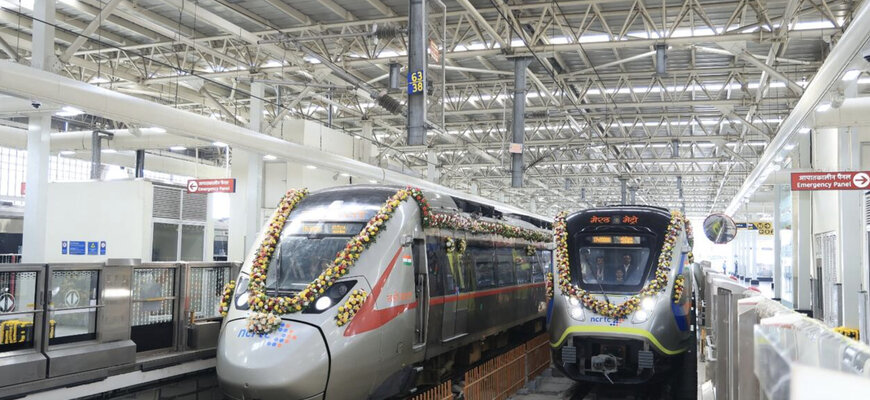
In the urban rail transport and railway signalling systems sectors, Alstom has commenced commercial operations of the remaining stretch of the Namo Bharat Regional Rapid Transit System (RRTS) corridor and the 21 km Meerut Metro line. The project integrates high-speed regional rail and metro services using ETCS Hybrid Level 3 signalling over LTE 4G.
ETCS Hybrid Level 3 over LTE 4G in Urban Metro
Meerut Metro becomes the first metro system globally to operate with ETCS Hybrid Level 3 signalling over LTE 4G. The system combines moving-block functionality with trackside train detection, enabling optimized headways, improved capacity utilisation and enhanced operational safety.
The signalling solution integrates train control, telecommunications, LTE radio communication and platform screen door systems within a unified architecture. ETCS Hybrid Level 3 allows more flexible train spacing compared to conventional fixed-block systems, supporting higher line efficiency.
High-Speed Urban Performance
The Meerut Metro trains are designed for a maximum speed of 135 km/h and operate at up to 120 km/h, positioning them among the fastest urban metro systems in India.
The Namo Bharat RRTS corridor connects Delhi, Ghaziabad and Meerut, integrating inter-city rapid transit with intra-city metro operations. The newly inaugurated sections include:
- New Ashok Nagar to Sarai Kale Khan (5.5 km)
- Meerut South to Modipuram (21 km)
- Meerut Metro line (21 km, 12 stations)
Four stations provide seamless interchange between RRTS and metro services.
Rolling Stock Designed and Manufactured in India
The trainsets were engineered at Alstom’s Hyderabad engineering centre and manufactured at Savli, Gujarat. Propulsion systems and electrical equipment were produced at the Maneja facility in Gujarat.
Under the 2020 contract awarded by the National Capital Region Transport Corporation (NCRTC), Alstom’s scope included:
Rolling Stock Designed and Manufactured in India
The trainsets were engineered at Alstom’s Hyderabad engineering centre and manufactured at Savli, Gujarat. Propulsion systems and electrical equipment were produced at the Maneja facility in Gujarat.
Under the 2020 contract awarded by the National Capital Region Transport Corporation (NCRTC), Alstom’s scope included:
- 180 RRTS cars (30 trainsets)
- 30 MRTS cars (10 trainsets)
- Signalling, train control and telecommunications systems
- Platform screen doors and LTE radio communication
- 15-year comprehensive maintenance services
The trains are based on the Adessia commuter platform and are designed to meet international safety standards.
Passenger-Centric and Accessibility Features
The Meerut Metro commuter trains incorporate:
Passenger-Centric and Accessibility Features
The Meerut Metro commuter trains incorporate:
- Overhead luggage racks
- Passenger information displays
- USB charging sockets
- Dedicated wheelchair spaces
- Stretcher space for emergency medical transfer
- Integrated emergency communication systems
These features support accessibility, safety and passenger comfort in daily urban commuting.
Regional Mobility Impact
The Delhi–Ghaziabad–Meerut RRTS corridor aims to reduce road congestion in the National Capital Region by enabling faster connections between satellite towns and economic centres. The system complements the existing Delhi Metro network and introduces high-speed regional connectivity integrated with metro operations.
With the deployment of ETCS Hybrid Level 3 signalling and high-speed India-manufactured trainsets, the project establishes a new technical benchmark for regional rapid transit and metro integration in India.
www.alstom.com
