
www.industry-india.com
08
'26
Written on Modified on
Alstom trains and CBTC signalling enter service on Indore Metro expansion
Movia trainsets, Urbalis Forward signalling and a 15-year maintenance programme support safer, higher-capacity urban transport across Madhya Pradesh.
www.alstom.com
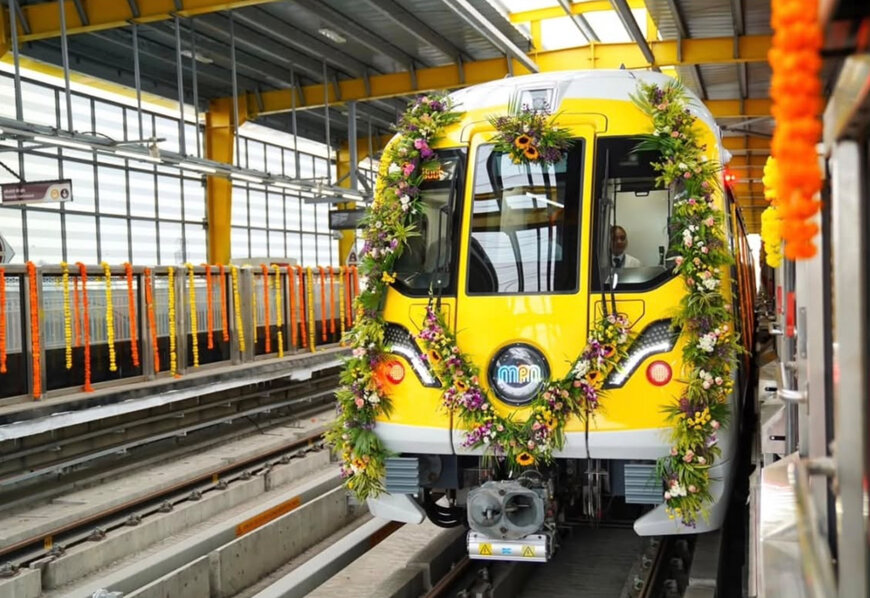
Alstom has initiated revenue operations for the extended municipal metro network in Madhya Pradesh, delivering a comprehensive suite of transit solutions that includes automated trainsets and integrated telecommunication frameworks. This deployment targets the urban mass transit sector, establishing high-capacity, energy-efficient mobility infrastructure to support heavy passenger volumes across expanding city corridors.
High-Capacity Rolling Stock and Energy Optimization
The transit expansion utilizes three-car metro trainsets engineered to operate at a maximum speed of 80 kilometers per hour. Each vehicle configuration is designed to accommodate up to 1,125 passengers, comprising 144 seated and 981 standing individuals, while featuring dedicated accessibility zones for reduced mobility. To achieve measurable energy efficiency, the train traction systems rely on regenerative braking mechanisms that capture and reuse kinetic energy during deceleration. This power recovery is further supported by smart ambient lighting systems engineered to lower overall electrical consumption. The rolling stock is manufactured domestically at a facility in Savli, Gujarat, adhering strictly to localized supply chain requirements.
Automated Signalling and Train Control Mechanisms
The 31.5-kilometer transit line, which currently operates a 16.72-kilometer mainline segment across 16 stations, utilizes a specialized communications-based train control architecture. The network functions at Grade of Automation 1 (GoA1) utilizing continuous Automatic Train Protection (ATP) protocols. This signaling framework enables safe, high-frequency train movements by maintaining precise dynamic safety envelopes around each vehicle, effectively minimizing wait times and facilitating future capacity expansions without requiring structural track alterations.
Digital Diagnostics and Security Integration
Operational stability is maintained through a Train Control and Management System (TCMS) that functions alongside an automated track inspection mechanism. This architecture ensures high-speed data transmission for the real-time monitoring of both rolling stock performance and physical track conditions. Security protocols are enforced via continuous closed-circuit television surveillance and software-driven intelligence capable of unattended object identification and empty train detection. The network also maintains direct, encrypted communication links between the onboard operator and the central control facility.
Lifecycle Management and Maintenance Architecture
To support continuous transit availability, the deployment includes a 15-year comprehensive maintenance framework. This service agreement covers all mechanical components and incorporates a dedicated seven-year maintenance cycle specifically for the signaling, train control, and telecommunication network. By utilizing predictive digital maintenance solutions, local transit authorities can secure peak operational performance and stabilize daily service delivery across the metro system over its operational lifecycle.
Additional Context:
This section details technical specifications and competitive benchmarking not included in the original product announcement
Within the urban rail transit sector, communications-based train control systems represent the baseline standard for high-capacity metro automation. Comparable signaling technologies, such as the Siemens Trainguard MT and Hitachi Rail control architectures, provide similar moving-block operations and integrated automatic train protection capabilities. The primary benchmark for evaluating these systems across the industry is the measurable reduction in headway times between active trains, which directly controls passenger throughput. By implementing dynamic moving-block principles, these control networks compete on maximizing track capacity without requiring physical infrastructure expansions, while rolling stock manufacturers compete on energy efficiency metrics through the deployment of regenerative braking hardware and optimized car body mass.
Edited by Natania Lyngdoh, Induportals editor, assisted by AI.
www.alstom.com
